Excavation is one of the least visible but most consequential phases of any construction or land development project. Done well, excavation creates the precise conditions that allow a building to stand securely, a drainage system to function properly, a road to carry traffic without premature failure, and a landscape to perform as designed. Done poorly, excavation problems are among the most expensive and disruptive issues a property owner or developer can encounter because they are buried beneath everything that comes after them.
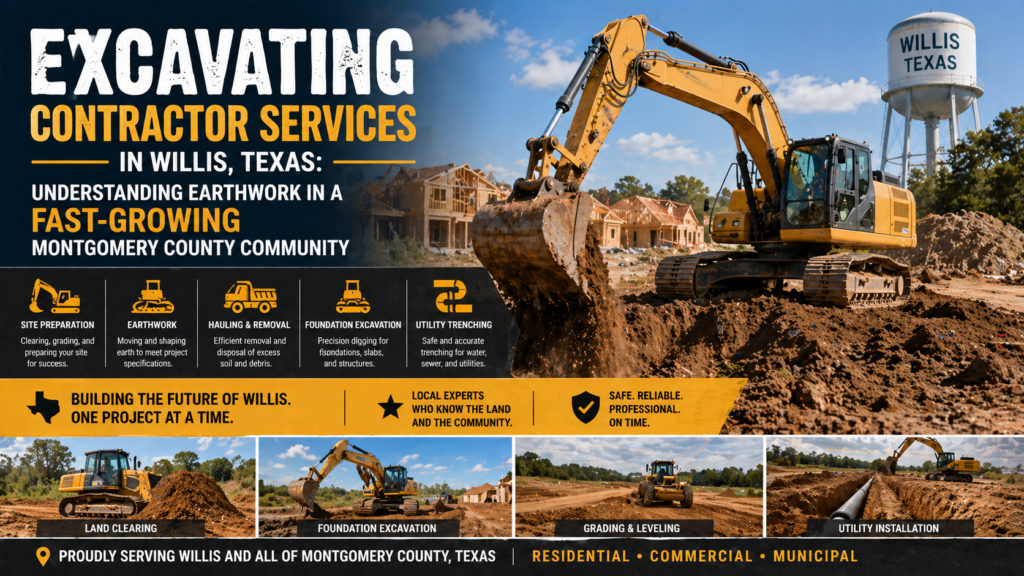
In Willis, Texas, where the pace of residential and commercial development has been among the most intense in the entire Houston metropolitan region, Excavating Contractor Willis services are in constant demand. Understanding what excavation involves, what the specific challenges of the Willis environment present, and how professional excavating work sets the stage for successful construction helps property owners make informed decisions about this critical phase of their projects.
What Is Excavation?
Excavation is the process of removing earth, rock, and other materials from a site to achieve a desired grade, shape, or depth. The term covers a broad range of activities, from shallow grading and drainage work to deep foundation excavation for large commercial or residential structures.
Grading and site preparation involve reshaping the surface of a property to the elevation and contour required for construction or other use. This may mean cutting high spots down, filling low spots up, and establishing a level building pad that provides the stable, even surface that foundations require. Proper grading also establishes the drainage patterns that direct water away from structures and off the property without pooling or eroding the site.
Foundation excavation digs below the existing grade to create the space needed for footings, piers, basement walls, or other foundation systems. In this part of Texas, foundation types vary with soil conditions slab-on-grade foundations are common across much of the Houston metro, but pier and beam systems are used in areas with expansive clay soils or other challenging conditions that require a foundation design that can accommodate soil movement.
Utility trenching creates the channels through which water lines, sewer pipes, electrical conduits, and telecommunications infrastructure are installed. Trenches must be excavated to precise depths and slopes to meet code requirements and to ensure that the utility systems they contain function correctly. In many cases, trenching and other utility work requires coordination with municipal engineers and utility companies, particularly where new development connects to existing public infrastructure.
Drainage installation involves excavating channels, retention areas, detention features, and subsurface drainage systems that manage water on a property. In a region like Montgomery County which receives approximately 48 inches of annual rainfall and has experienced major flood events associated with hurricane systems drainage engineering and excavation are not optional enhancements but essential functional systems for any developed property.
Willis and the Challenges of East Texas Soils
The Willis area sits within the East Texas pine belt on a landscape shaped by millions of years of sedimentary deposition. The soils in and around Willis reflect this geological history in ways that have direct implications for excavation and construction.
Much of the area around Willis features sandy loam soils that drain relatively well and are workable under most conditions. However, as you move deeper below the surface, clay-rich layers appear that behave very differently expanding when moisture content increases and contracting when they dry out. This shrink-swell behavior is one of the most significant challenges for foundations and subsurface structures in East Texas, and it is a key reason why professional site assessment and soil evaluation are important before any major excavation project begins.
Areas near drainage features the creeks and small rivers that dissect the Willis area as they work their way toward Lake Conroe and the San Jacinto watershed often feature floodplain soils with high organic content that are compressible and poorly suited for direct foundation bearing. Excavation and site preparation in these areas may require special techniques including subgrade stabilization, the import of engineered fill materials, or the design of foundation systems that account for the challenging soil conditions.
The relatively flat topography of much of the Willis area also creates challenges for drainage. Without sufficient natural slope to carry water away from developed areas, engineered drainage solutions detention ponds, swales, underground drainage systems, and carefully graded surface profiles are critical components of any well-designed development project. An excavating contractor working in Willis must understand these drainage dynamics and plan earthwork accordingly.
The Growing Demand for Excavation Services in Willis
The population of Montgomery County grew by more than 30,000 residents in a single year between 2024 and 2025, making it one of the fastest-growing counties by raw numbers in the entire United States. Willis and the surrounding unincorporated areas of northern Montgomery County have absorbed a significant share of that growth, with new residential subdivisions, multifamily housing, commercial development, and infrastructure expansion all proceeding simultaneously.
Every new home requires foundation excavation. Every new subdivision needs utility trenching for water, sewer, gas, and electricity. Every new commercial building demands graded pads, parking lot preparation, and drainage infrastructure. Every new road extension requires precise earthwork to establish the subgrade that carries the pavement. The cumulative demand for professional excavating services in the Willis area is therefore enormous and growing.
This growth also means that the full spectrum of excavation project types is active in the market simultaneously. Small residential excavation jobs for single homeowners developing their lots coexist with large-scale commercial earthwork projects for developers building out shopping centers, industrial facilities, and multifamily housing complexes. An excavating contractor serving the Willis area needs both the versatility to handle a range of project scales and the local knowledge to work effectively in the specific conditions that the area presents.
Equipment and Technology in Modern Excavation
Professional excavating work relies on a fleet of specialized equipment matched to the scale and nature of each project. Understanding the equipment involved helps property owners appreciate why professional excavating contractors can accomplish efficiently what would be practically impossible by other means.
Tracked excavators are the primary earthmoving tool for most excavation projects. These machines combine a powerful hydraulic arm with interchangeable attachments standard buckets for general excavation, clamshell buckets for precise digging in confined spaces, hydraulic breakers for hard material, and grading blades for surface work that allow a single machine to perform a wide range of tasks. Tracked excavators can operate on slopes and in wet conditions where wheeled equipment would struggle, making them particularly valuable in the variable terrain of the Willis area.
Bulldozers perform large-scale earthmoving and rough grading work. Their wide blade can push significant volumes of material efficiently across open areas, making them the tool of choice for establishing rough grades on larger sites before finer work begins. Bulldozers also compact material as they move over it, contributing to subgrade preparation.
Compact equipment mini excavators, skid steer loaders, and compact track loaders allows excavation work to be performed in tight spaces, near existing structures, and in confined residential settings where larger machinery cannot safely maneuver. This equipment is essential for residential foundation work, utility trenching in developed areas, and site work on smaller lots.
Motor graders and laser-guided grading systems enable the precise surface preparation required for slab foundations, parking lots, and other applications where consistent elevation and slope are critical. Laser-guided grade control systems allow operators to achieve tolerances of a fraction of an inch across large areas, a level of precision that is essential for slab construction and drainage performance.
Drainage and the Long-Term Performance of Excavated Sites
In Willis, Texas, where annual rainfall exceeds 48 inches and tropical weather events can deliver extreme precipitation over short periods, the drainage design embedded in excavation work is not a secondary consideration it is fundamental to how well a developed property performs over its lifetime.
Excavation that establishes correct drainage grades ensures that rainfall moves predictably away from foundations, off parking surfaces, and into appropriate collection points rather than ponding on the site, eroding disturbed soils, or infiltrating around structural elements. Properly designed and excavated detention and retention features provide temporary storage for stormwater, releasing it slowly to avoid overwhelming downstream drainage systems a requirement that is increasingly enforced by Montgomery County and municipal drainage regulations as development density increases.
An excavating contractor who understands these drainage dynamics and incorporates them into every phase of earthwork produces sites that function well long after the construction is complete. One who treats drainage as an afterthought creates conditions that lead to water damage, foundation movement, and pavement failure problems that are expensive to correct and can follow a property for decades.