When a business lives or dies by its phone lines, the hardware on every agent’s desk stops being a detail and becomes a core asset. Call centers, busy support desks, and hospitality front offices all share the same demand: phones that handle high call volume without dropping quality. For those environments, a robust business handset like the Fanvil V61G Prime Business Phone is engineered to keep agents productive shift after shift.
This guide focuses on high-usage settings rather than the casual office. If your team fields dozens of calls per person each day, the priorities shift toward durability, fast call handling, and features that reduce agent fatigue.
What High-Volume Environments Really Need
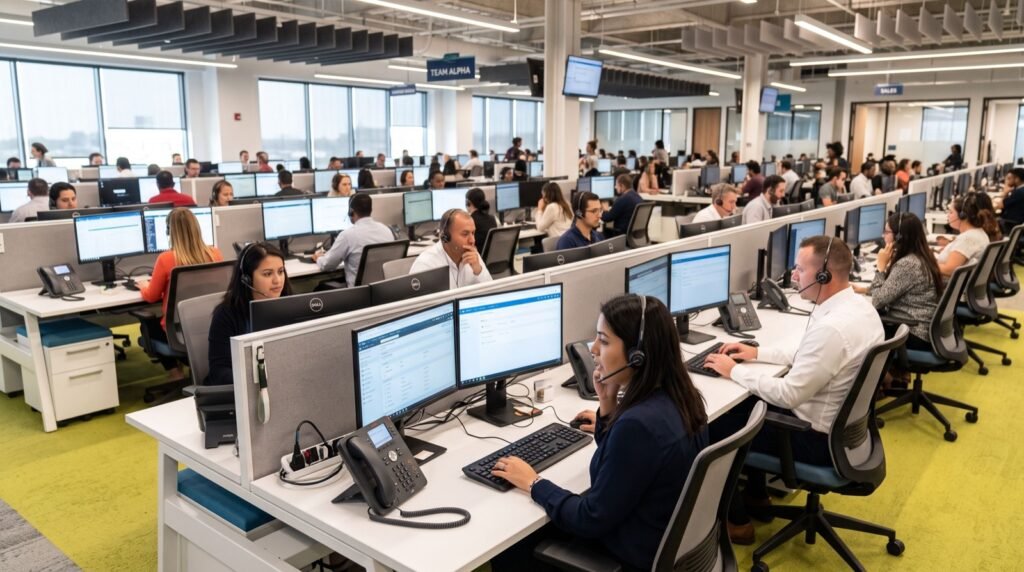
An occasional-use phone and a call-center phone look similar but face very different demands. In a contact center, the handset is touched hundreds of times daily, headsets are essential, and every second saved on call handling multiplies across the team.
The features that separate a true business-grade IP phone from a basic one include:
- Multiple programmable line keys for quick transfers and busy-lamp field monitoring.
- Dedicated headset and EHS support for hands-free, all-day comfort.
- Gigabit pass-through so the agent’s PC shares one cable without slowdown.
- A responsive color display that makes queues and caller info easy to read.
Reducing Agent Fatigue and Errors
Small friction points add up across a shift. A phone that speeds routine tasks keeps agents calmer and customers happier.
Fast Call Control
One-touch transfer, hold, and conference buttons cut the fumbling that frustrates callers. Busy-lamp field keys let an agent see who is available before transferring, avoiding dead-end hand-offs.
Headset Comfort
All-day headset use makes electronic hook switch support and wideband audio non-negotiable. Clear sound reduces the strain of asking callers to repeat themselves, which shortens calls and lowers stress.
Reliability Under Load
Business-grade phones are built for constant use, with sturdier components and firmware tuned for stability. In a call center, a phone that reboots mid-shift is far more costly than a slightly higher purchase price.
Matching Phones to High-Usage Roles
Even within a busy operation, roles differ. The table maps common high-volume positions to the right handset traits.
| Role | Priority Feature | Why It Matters |
|---|---|---|
| Inbound support agent | Headset + line keys | Constant calls, frequent transfers |
| Hotel front desk | Busy-lamp field | Route guests to the right department |
| Supervisor | Call monitoring keys | Barge, whisper, and oversight |
| Reservations | Color display | Read caller and queue detail fast |
Operations sourcing fanvil ip phones in Karachi for a contact center typically standardise on one prime business model across the floor, which keeps provisioning simple and spare-part logistics easy.
Deploying a High-Volume Phone Fleet
Scale changes everything. A five-phone office and a fifty-seat call center need different discipline.
- Size your PoE switches for the full seat count plus growth headroom.
- Put voice on a dedicated VLAN with strict QoS to protect call quality.
- Auto-provision every phone from one master template for consistency.
- Standardise headsets so training and spares stay simple.
- Test peak-hour load before go-live, not after complaints arrive.
Lessons From the Contact-Center Floor
The most common failure in busy deployments is under-provisioned bandwidth at peak hours. A system that sounds perfect at 9 a.m. can crackle at noon when everyone is on a call. Sizing for peak, not average, is the fix. Bringing in reliable local experts to model peak load prevents that expensive surprise.
A practical tip from the floor: keep two or three pre-provisioned spare phones in a drawer. When a unit fails during a shift, a swap takes seconds instead of leaving an agent offline while IT rebuilds a config.
Measuring the Payoff
In a high-volume operation, the right phone hardware shows up in the numbers, not just in comfort. Faster call control shaves seconds off average handle time, and clearer audio reduces repeat questions that drag calls out. Across a fifty-seat floor, trimming even ten seconds per call frees up meaningful capacity during peak hours.
Track a few simple metrics after deployment to prove the value: average handle time, transfer success rate, and the count of hardware-related tickets. Business-grade phones typically cut all three, and that improvement compounds every single shift. Owners in Karachi who watch these figures quickly see why paying for durable, feature-rich handsets beats chasing the lowest sticker price.
Integrating With Your CRM and Queues
Modern business IP phones do more than ring. Paired with a capable PBX, they support call queues, skills-based routing, and screen pops that surface caller history to the agent. When the handset, the queue logic, and the CRM work together, an agent greets a returning customer by name and context, which lifts satisfaction and first-call resolution. Confirm these integrations with your platform before rollout so the whole stack pulls in one direction.
Standards, Security, and Uptime
These phones rely on the Session Initiation Protocol, the IETF standard published as RFC 3261, which governs how calls are set up and torn down. In a high-value environment, secure the system with TLS signalling, strong admin credentials, and monitoring for abnormal international traffic. Toll fraud targets busy lines precisely because the volume hides misuse.
Frequently Asked Questions
What makes a business IP phone different from a basic one?
Business handsets add more programmable line keys, busy-lamp field monitoring, headset and EHS support, Gigabit pass-through, and sturdier hardware built for constant, all-day use in high-volume settings.
Do call center agents need headsets with IP phones?
Yes. For all-day calling, headset and electronic hook switch support are essential for comfort and productivity. They free the hands for typing and reduce the fatigue of holding a handset for hours.
How do I keep call quality stable during peak hours?
Size bandwidth for peak, not average, load. Use a dedicated voice VLAN with QoS, adequate PoE switches, and test under simulated busy conditions before going live to catch congestion early.
How many IP phones can a call center run?
The phones themselves impose no limit. Your PBX license, network capacity, and PoE budget set the ceiling, so plan switches and bandwidth around your full seat count plus room to grow.
Planning for Disaster Recovery
A call center cannot afford silence. Build simple resilience into the plan so a single failure never takes the whole floor offline. Keep a spare PoE switch on hand, document the PBX configuration so it can be restored quickly, and set up call forwarding to mobiles or a backup site if the primary internet link drops. Cloud PBX platforms make this easier, because agents can log in from anywhere and keep answering calls even if the office loses connectivity. For hospitality and support operations where a missed call is a lost customer, that continuity planning pays for itself the first time a line goes down.
Conclusion
High-volume environments reward hardware chosen for endurance, speed, and agent comfort, and prime business fanvil ip phones are made for exactly that pressure. Match handsets to roles, provision for peak load, keep spares ready, and secure the system. Do that, and your call center or front desk will handle every rush without missing a beat.